What does it say about an audience who, while watching a character make a speech that has sparked screeching protests and angry walkouts in its run across Europe, sit politely listening until the end?
The booing does come, but only after the actor playing a far-right politician and kidnap victim (Romeu Costa) has finished a half-hour invective that takes in everything from the scourge of minorities to that of elites, homosexuals, and the far-left. It is a masterclass in rightwing rabble-rousing, with its appropriation of the word “freedom”. Yet on press night at its British premiere, all that is summoned in response is nervous laughter, a chorus of coughs and a few loud whistles.
Is this because audiences have heard about the furore around Tiago Rodrigues’s play and know what to expect, or is it something more insidiously British in its politeness? There could be a host of excuses: we know it is only theatre; we feel disconnected from fascism in a way that audiences in Germany – or in Portugal, where the production is from – may not. Or is it simply that we want to hear the character out?
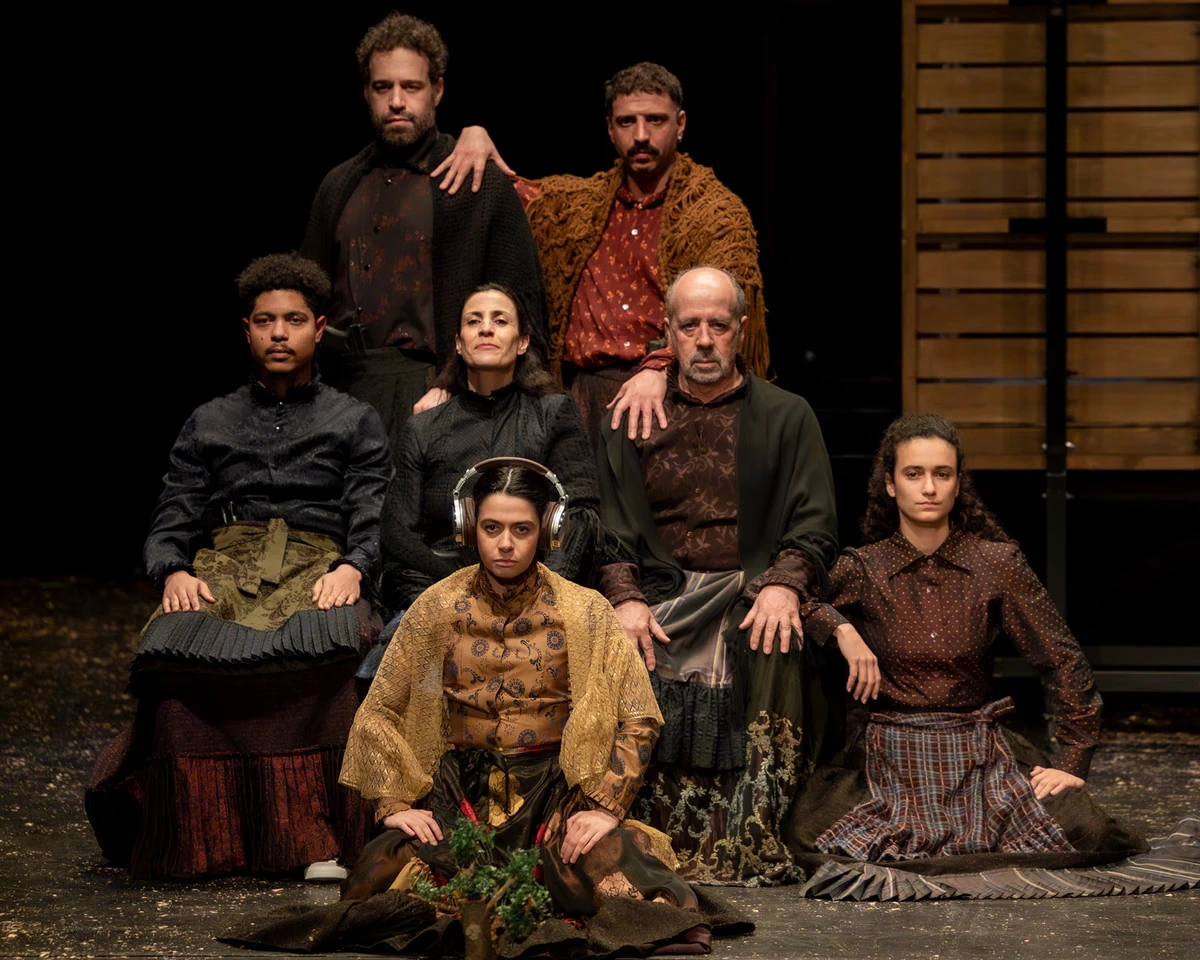
The politician takes the floor at the end. The central drama features a family that kidnaps and kills a single “fascist” on an annual basis as a ritual protest against the far right. Characters wear old-fashioned dresses and shawls (including the men) and speak in peculiarly comic tones, so they look and sound like Lorcan parodies. They are all called Catarina too, to honour the original Catarina, a protester murdered at the hands of President António de Oliveira Salazar’s authoritarian government in 1954, after which the family’s grandmother commanded her family to take on these annual killings.
If the point of the play is to compel an audience into action, we are Hamlet, immobilised. But it seems more complicated than that. Set in a near-future in which a far-right government is on the verge of changing the constitution in Portugal, its central ethical debate revolves around armed protest and the question of whether to suffer under fascism or to take arms against it. Every family member has abided by Catarina’s rule until one (Beatriz Maia) says she can’t justify it, and refuses to shoot.
The justifications for political violence here are presented in pithy summaries, via English surtitles: “It is not enough to be against, you must act against,” says one character. “You cannot fight intolerance with tolerance,” says another.
But there are so many other gnomic and mannered tics to the dialogue. Characters babble on about nothing, it seems. There are unfunny jokes about veganism (a pop at the “woke” left?) and a riff on the flight of swallows (the birds are later likened to immigrants by the politician). They flog the same arguments on violent protest. You wonder if it is a critique of the political left: that it can only talk on interminably or in-fight in the face of real fascist threat.
And as post-dramatic theatre, aware of itself and refusing to cast fourth-wall illusions, it is a play of maddening inaction – the family member who won’t shoot, the drama that won’t give us any drama, or not until its final stretch.
So it is arduous to watch, in spite of Fernando Ribeiro’s origami-like set of a slatted house, foregrounded by a dining table reminiscent of The Last Supper, that rearranges itself beautifully. Then, suddenly, the crushing boredom is punctured by the shock of gunfire and the politician’s speech. Have we been deliberately lulled into an almost soporific state?
This paradox of boredom and shock might encapsulate the political juncture at which Europe stands, with AfD on the rise in Germany and President Le Pen potentially six months away in France. If so, is the play a starting-gun for those of us walking zombie-eyed, or wilfully blind, into a fascist future? The politician rattles on and on. He is not named but we know him. Do we wish him dead?